
Thread Lift
Thread Lifts in Vancouver and Abbotsford B.C.
Thread lift is a minimally invasive procedure used to lift and reposition areas of the face where skin has started to relax. As collagen and elastin change over time, this can show as softening in the face or areas of the body.
Rather than adding volume, thread lifts work by gently lifting tissue and supporting structure. In the face, this can help refine the jawline, lift the cheeks, and improve overall contour. Threads can also be used in areas like the neck and body, including the abdomen, to support skin and improve firmness.
Compared to surgical procedures, thread lifts involve less downtime and are performed in clinic.
Thread Face Lift Before and After
Take a look at our patients' thread lift transformations.
Featured Thread Lift Treatments

Non-Surgical Nose Job
A nose thread lift can lift your bridge and contour your nose, giving it a natural and balanced appearance.

Thread Face Lift
A thread face lift takes a restorative approach, focusing on lifting and supporting the face to help bring back structure and balance.

Body Thread Lift
Threads are not just for the face. A body thread lift can be used in areas like the abdomen, legs, breasts, and buttocks to support the skin and improve overall firmness.
Thread Lift Before and After
This gallery contains nudity.

before and after thread lift

before and after thread lift

before and after under eye thread lift

before and after body thread lift

Nose thread lift

Under eye thread lift

Ab thread lift

Breast thread lift to address asymmetry

Restore fullness and reduce stretch marks with a breast thread lift

Jowl and chin thread lift

Neck thread lift
-

Meet Dr. Mark Godley
With a background as a medical doctor and training in anesthesia, Dr. Mark Godley brings a strong understanding of facial anatomy and pain management to thread lifting. He has trained internationally, including at Aptos headquarters in Tbilisi, Georgia, where he learned directly from Marlen Sulamanidze, the plastic surgeon who developed the Aptos thread lifting technique.
He is known for his Invisilift technique, a restorative approach that focuses on lifting and repositioning tissue without adding volume. Thread lifting is often part of a multi modality plan, combined with other treatments to support structure, skin quality, and longer term results.
-
What is a Thread Lift?
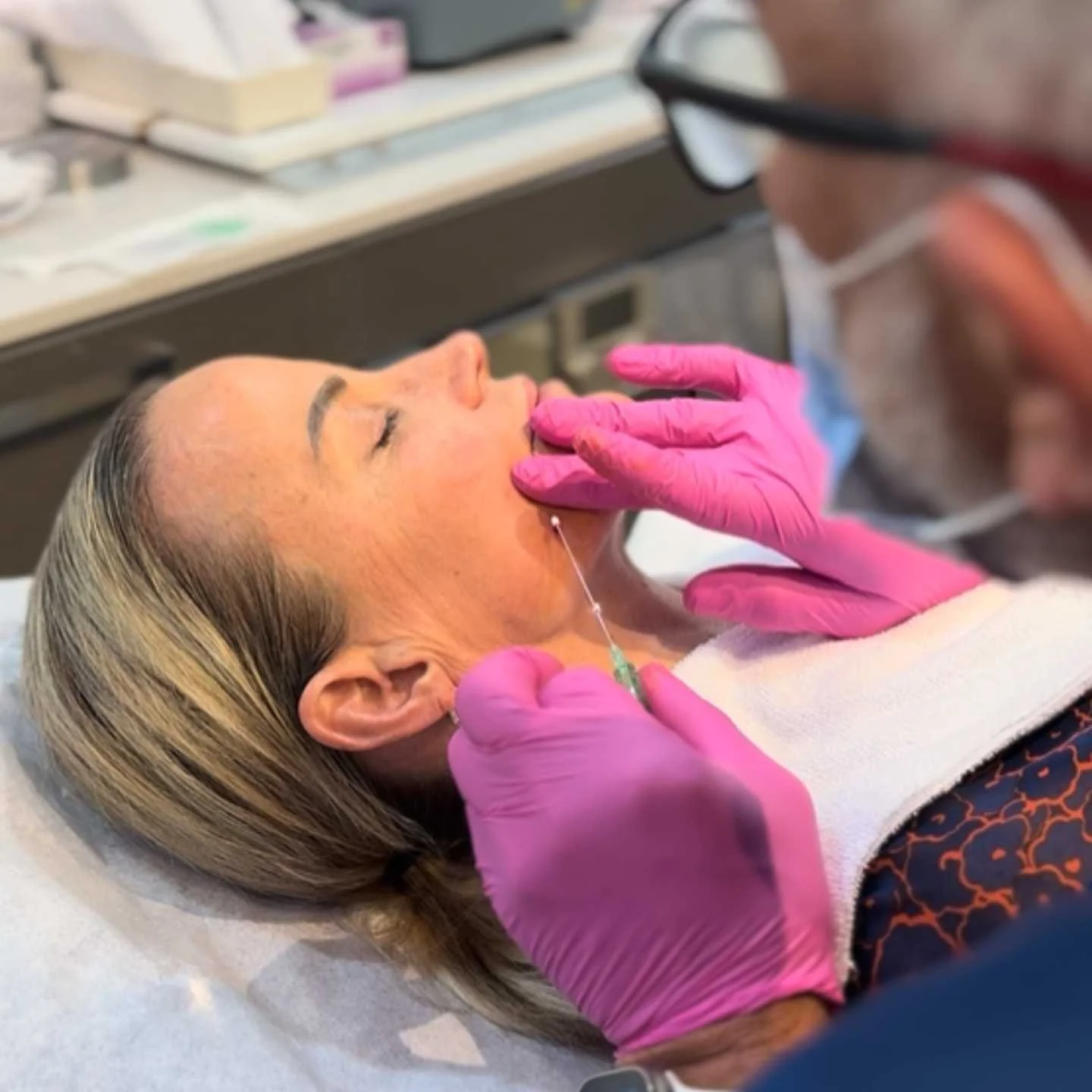
A thread lift is a minimally invasive treatment that uses dissolvable sutures placed under the skin to lift and reposition tissue. These threads are made from materials commonly used in medical stitches, such as PDO and PLA.
Different types of threads are used depending on the goal. Lifting threads are used to reposition and support tissue, while mono threads are placed more superficially to help improve skin quality.
Thread lifts are often used in areas like the cheeks, jawline, and around the eyes, and can also be used on the body. Treatments are done in clinic with minimal downtime.
Thread Lift FAQ
Thread Lift Frequently Asked Questions
-
Dr. Godley: It is important to understand what a thread lift is designed to achieve. It does not provide the same degree or longevity of correction as a surgical facelift. For an appropriate candidate, however, it can offer a refreshed and lifted appearance while preserving their natural features. Many of my patients want a noticeable improvement with significantly less downtime than surgery. They want to look refreshed and still look like themselves. The key is matching the treatment to the patient’s anatomy and expectations. If someone has significant excess skin or wants a greater degree of correction we need to discuss whether surgery would better meet their goals.
-
Dr. Godley: The threads gradually dissolve but the collagen they stimulate can continue supporting the skin beyond that point. This collagen-related support may continue for 12–24 months, although the visible lifting effect and duration of results vary.
Maintenance treatments may help sustain the improvement. Depending on the patient, we may also consider complementary treatments such as biostimulatory fillers like Radiesse, Sculptra or PRF as part of an ongoing treatment plan.
-
Dr. Godley: Yes, a previous thread lift does not necessarily automatically rule out a surgical facelift. Threads can be an option for patients who wish to defer surgery while leaving open the possibility of considering it later. My surgical colleagues have recommended allowing around a year between a thread lift and a subsequent facelift. However, the surgeon needs to determine the appropriate timing based on the threads used, their placement and the patient’s tissue response. An experienced facial surgeon can assess these changes and plan the procedure accordingly. It is important to share your full treatment history when discussing surgery.
For more on recovery, results and common misconceptions, read our 7 Thread Lift Myths You Shouldn’t Believe.
-
Dr. Godley: We all like immediate gratification but patients need to allow time for healing after a thread lift. Swelling can occur from inserting the cannula, administering local anaesthetic and the tissue’s response to the procedure. In my practice, I describe the more noticeable swelling during the first week to ten days as “macro swelling.” Less visible swelling beneath the surface, which I call “micro swelling,” can persist for two to four weeks on average. These are approximate timelines, and recovery varies between patients. That early swelling can make it difficult for patients to judge their results. Sometimes they worry the treatment has not worked because they are assessing it too soon. In my practice I encourage patients to allow 4 weeks and up to ten weeks before we assess the more settled thread lift results. The tissue response and collagen production develop over time, so the appearance immediately after treatment does not tell the whole story
Many patients can return to light everyday activities within 24–48 hours. However, that does not mean all swelling or bruising will have disappeared. As we discussed earlier, the tissues continue healing beneath the surface. Patients should follow their personalised aftercare instructions, including temporarily avoiding strenuous exercise and exaggerated facial movements. It is important to allow some flexibility in your schedule because recovery varies between individuals -
Dr. Godley: I use those terms to help explain the difference between swelling that patients can see and the healing that continues beneath the surface. During roughly the first ten days, patients may notice what I describe as “macro swelling.” Friends and family might not notice it as much, but the patient can often see or feel a difference in the treated area.
As the visible swelling settles, there can still be tenderness or a feeling of fullness beneath the skin. This is what I refer to as “micro swelling.” I sometimes compare it to a sponge that looks dry on the outside but is still wet on the inside. You expect it to feel light when you pick it up, but it feels heavier than expected. Similarly, the treated area can feel fuller or heavier even when there is less visible swelling. The recovery experience varies between patients.
-
Dr. Godley: There are two things to consider: the material the thread is made from and its design.
Common materials include PDO (polydioxanone), PLA (polylactic acid) and PCL (polycaprolactone). I am particularly interested in PLA threads for their longevity and potential to stimulate collagen production.
The different thread designs serve different purposes:
Cog or barbed threads have small projections that grip the tissue, allowing us to lift and reposition it.
Mono threads are smooth threads used primarily to stimulate collagen and improve skin quality, rather than physically lift tissue.
Screw threads have a spiral or twisted design and are used to encourage collagen production and subtle fullness in selected areas.
You may also have heard of brands such as Aptos, Silhouette InstaLift and Silhouette Soft, all of which I have experience with.
Choosing the threads is only part of the process. The placement technique, tissue quality and the outcome we are trying to achieve all help guide the treatment plan.
For a closer look at the different materials and designs, read our Thread Lifting Essentials guide.
-
Dr. Godley: I have been performing thread lifts since 2018. My training has taken me to Eastern Europe, the United States, Japan and Canada.
-
Dr. Godley: Tissue quality and the degree of skin laxity are important considerations. As we age the tissues can become less dense and the skin can become looser. When there is significant laxity or limited tissue support, a thread lift alone may not provide the outcome we are hoping to achieve.
That is why assessing the tissues before treatment is so important. In some cases, I would consider preparation before deciding whether to proceed with threads.
-
Dr. Godley: In selected patients, I may recommend a collagen-stimulating treatment, such as Radiesse or Sculptra, before considering a thread lift. The aim is to improve tissue quality and support. Radiesse contains calcium hydroxylapatite, and it is one of the treatments I use as part of this approach. This is a process that takes time. We may be looking at several months of preparation and reassessment rather than proceeding directly to threads. For some patients improving the tissues first may make a thread lift a more suitable option.
Featured Thread Lift Blog Posts


Related Treatments
-

Lip Filler
Subtle, hydrating lip filler in Vancouver and Abbotsford B.C.
-

Botox
Botox treatments in Vancouver and Abbotsford B.C.
-

RF Microneedling
RF microneedling treatments in Vancouver and Abbotsford B.C.